When someone asks how we prepare for a show, they expect an answer about brushing and shampoos. True, that is part of the story. But the real answer begins much earlier and has far less to do with coat than with trust.
Training the dogs can't wait for
We attend show training as often as three times a week when needed. Sometimes we practise at home, sometimes on a walk, sometimes at organised training. Not out of duty, but because I want the show position to feel as familiar to the dog as sitting in front of its bowl.
We work exclusively with positive reinforcement. Reward, voice, play. Never force. And the result of that choice is something people often find hard to believe: my dogs can't wait to train. When I pick up the lead for training, they are as delighted as before a walk. That is exactly why they behave in the ring as they do at home. For them it is not a test but something they already know.
This is not just my belief but a research finding. In 2020, Vieira de Castro and colleagues showed that dogs trained with aversive methods display more stress signals and higher cortisol than dogs trained with rewards. Positive reinforcement is therefore not only kinder but more effective.
What we actually practise
Show training is not trick training. It is habituation to three things the dog will experience in the ring.
The first is the stand. The dog learns to stand calmly in a position that shows its structure, and to hold it for a few moments without tension.
The second is a stranger's touch. The judge will examine the teeth, feel the body and check the structure. So at home I gradually accustom the dog to having its mouth opened and its body, paws and ears touched, always paired with something pleasant. When a stranger then does it, it is nothing unusual.
The third is the table. Toy breeds are judged on a table, an unnatural raised position for a dog. Practising on a table at home is essential, otherwise the dog finds itself lifted up for the first time in its life amid noise and strangers.
Sessions are short and frequent. A few minutes, always ending while the dog is still succeeding and enthusiastic. We never train until the dog tires of it.
Show day: how we reduce stress
Completely stress-free is not possible; anyone promising that is not telling the truth. Home is home and a show is a show. But we can do a great deal to reduce it to the smallest possible measure.
We arrive early. Far earlier than necessary. This gives the dogs time to acclimatise, sniff the space and settle. A dog arriving five minutes before its class enters the ring with all the arousal of the journey still in its body.
We avoid crowds and noise. We find a quieter corner, away from loud music, speakers and the busiest areas. The pen is covered so the dog is shielded from visual and auditory stimuli. This is not hiding; it is rest.
I stay calm. This is the hardest and the most important part. Sundman and colleagues showed in 2019 that the stress levels of dog and owner are synchronised, and that this is predicted by the owner's personality, not the dog's. If I am tense, my dog will be tense. So I do not carry expectations into the ring — I carry a dog.
We go straight home after the ring. We do not stay all day for company or curiosity. The dog has done its work and deserves peace. At home it can rest immediately in familiar surroundings.
Rest follows a show. A few days with no new events, no training, no visitors. Not because hormones need days — cortisol settles within about an hour (Beerda et al., 1998) — but because tension otherwise accumulates, and because the dog simply deserves rest.
Coat care: just like long hair
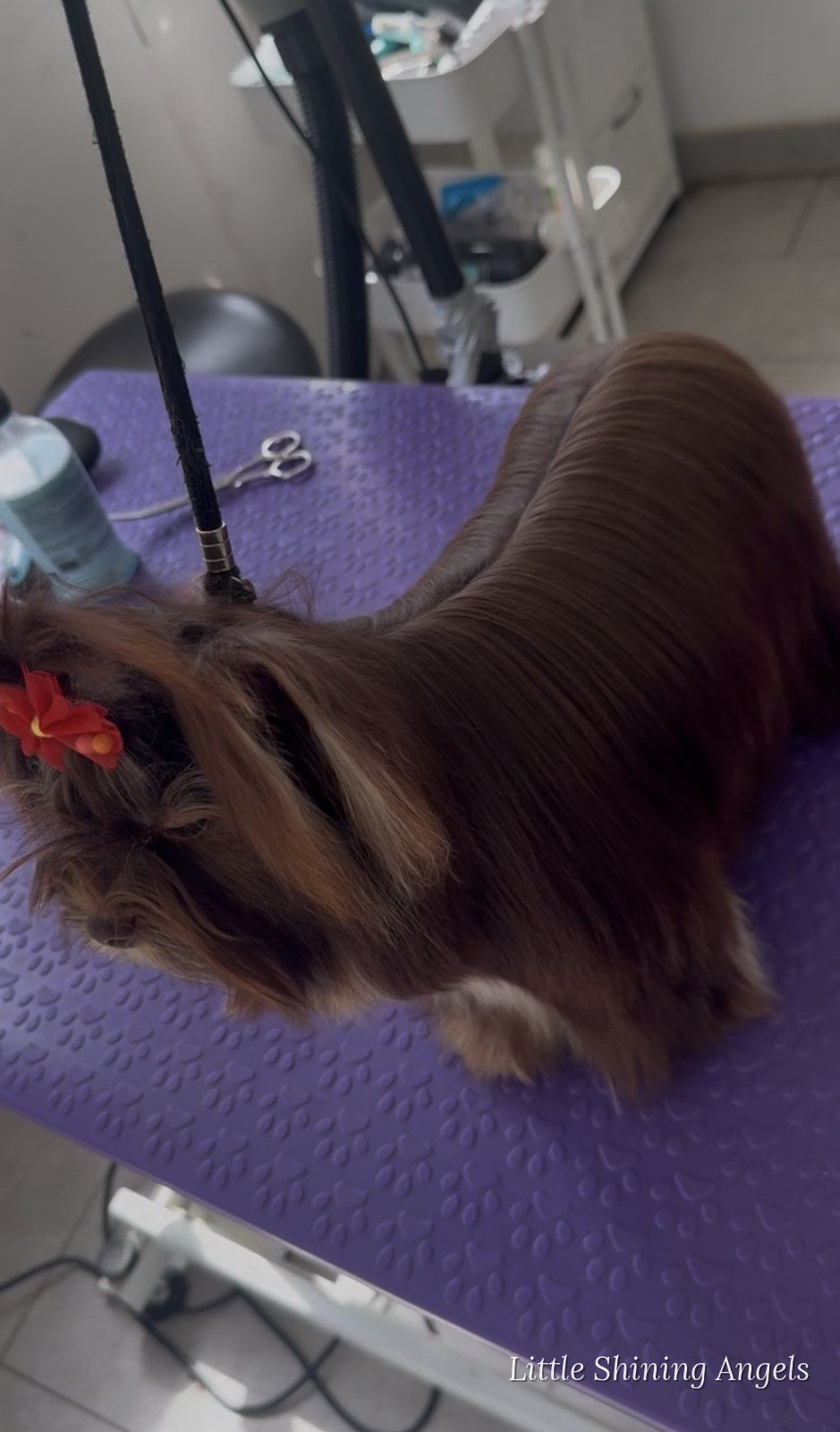
I like a comparison every woman understands instantly. If your daughter has long hair, you know it must be cared for, combed, washed with a good shampoo and protected, otherwise it breaks and tangles. With a dog with a long, silky coat it is no different at all.
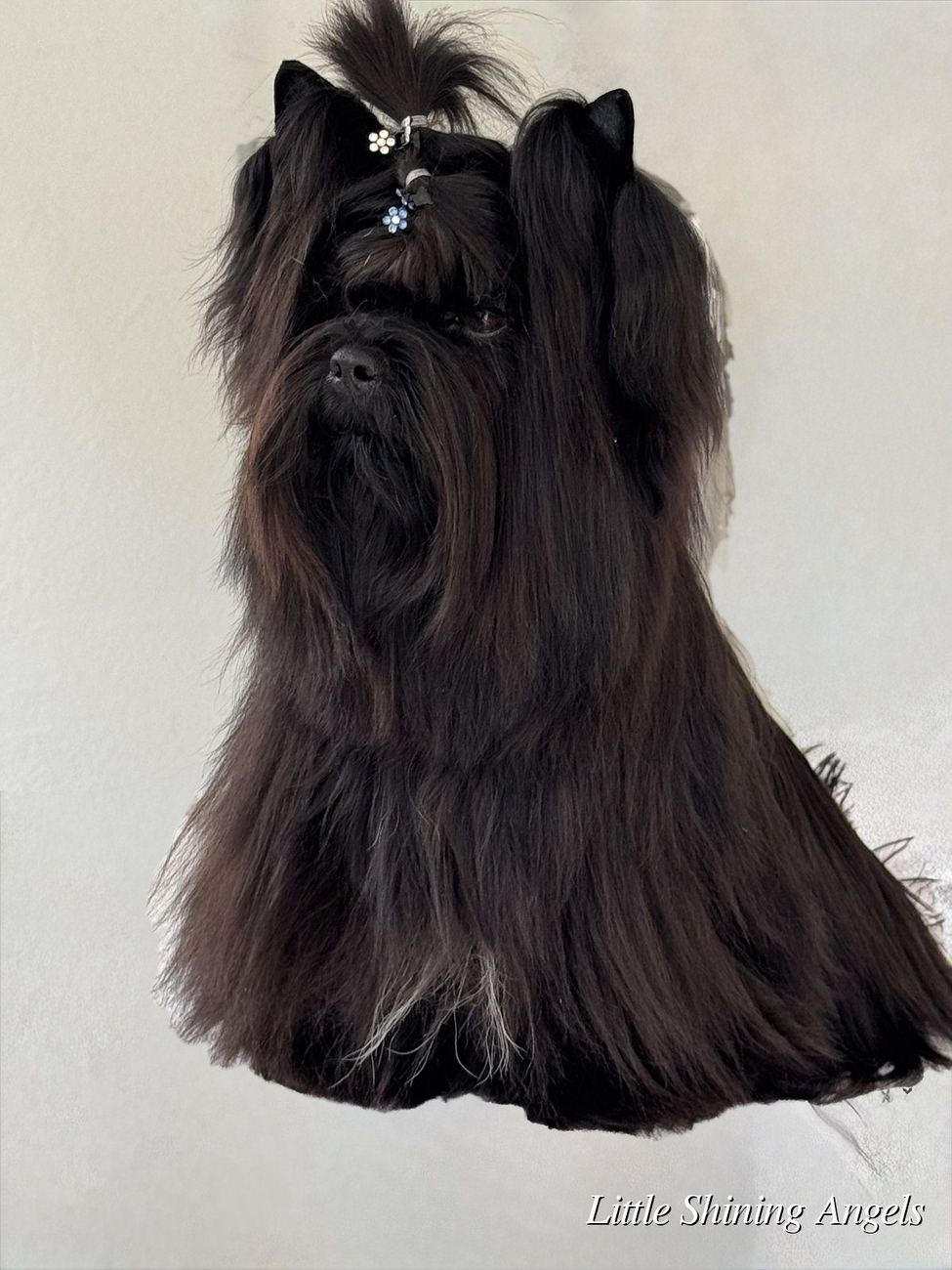
The Terrier and Biewer coat is special: it grows continuously, is closer in structure to human hair than to typical dog fur, and has no undercoat. So it does not shed — it breaks and mats if we do not care for it.
Bathing. Show dogs are bathed often, even weekly, as show groomers also recommend (American Kennel Club). We use top-quality shampoos and conditioners suited to a silky coat: mild cleansing products for the white areas, moisturising ones for the dark areas to deepen the colour.
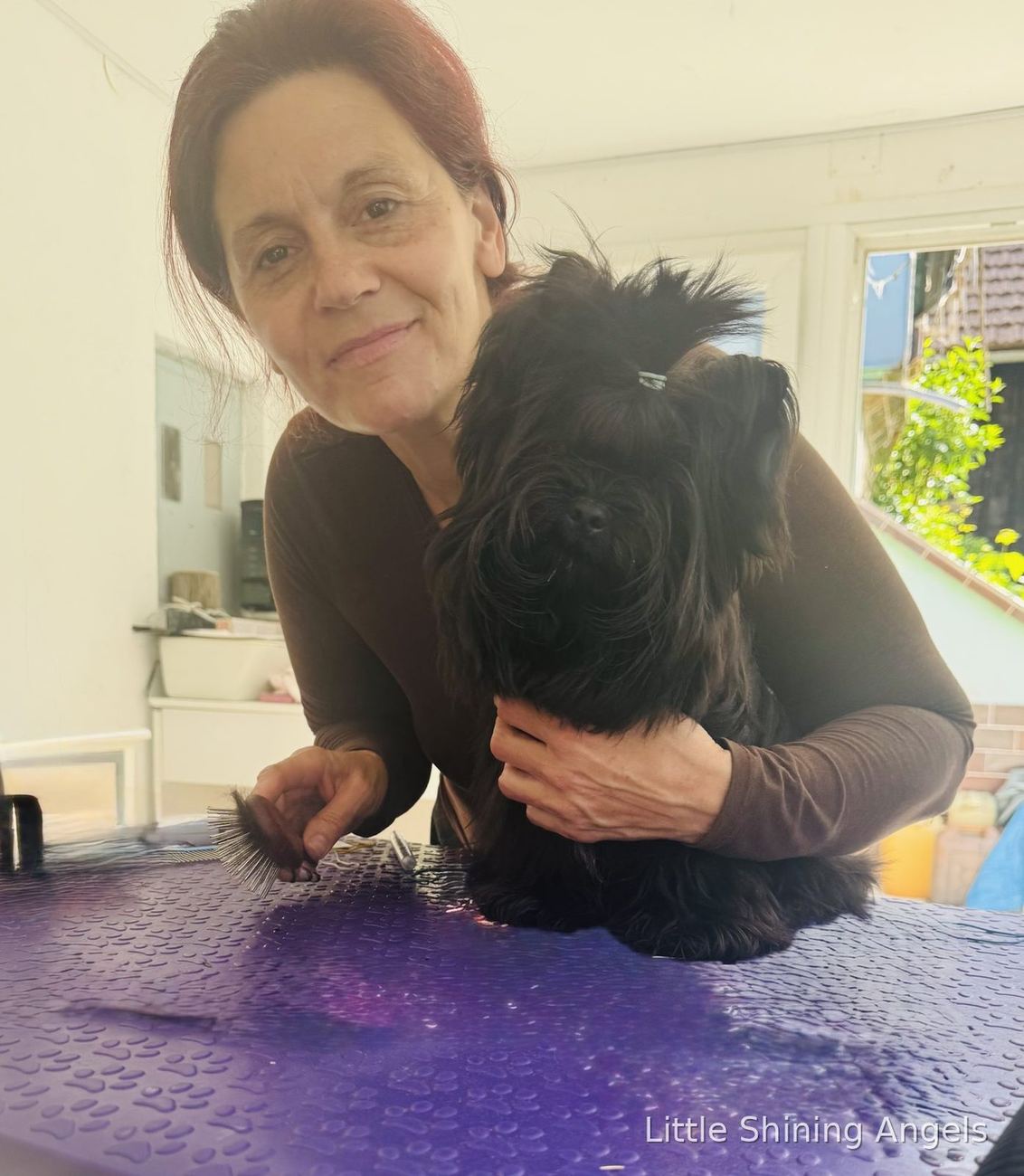
Brushing. At least every second or third day, depending on the terrain the dogs walk on and how much they play around the house. Grass, leaves and sand tangle the coat faster, so brushing after such days is essential.
And one rule many people do not know: never brush a dry coat. Always mist it first with water or a leave-in conditioner, otherwise it snaps. Brush in sections, from the tips upwards, never forcing through a knot.
Drying. Do not rub the coat with a towel — blot it. Then dry with cooler air while brushing in the direction of growth.
Wrapping. The long show coat is protected by wrapping it in special papers. This lets the dogs play and run freely while the coat stays intact.
And let it be clear: for all the grooming, my dogs are dogs first. They run, roll in the grass and live a full dog's life. Grooming exists so their coat does not trouble them, not so they can be ornaments.
A final thought
For us, preparing for a show is above all a relationship. A dog that knows what awaits it, that finds training a joy and that feels a calm human beside it does not go into the ring out of duty. It goes because it enjoys being with us. When that is no longer true, there is simply no showing.
Literature and sources
Vieira de Castro AC, Fuchs D, Morello GM et al. (2020). Does training method matter? PLOS ONE 15(12):e0225023.
Fernandes JG, Olsson IAS, Vieira de Castro AC (2017). Do aversive-based training methods actually compromise dog welfare? A literature review. Applied Animal Behaviour Science 196:1–12.
Sundman A-S et al. (2019). Long-term stress levels are synchronized in dogs and their owners. Scientific Reports 9:7391.
Beerda B et al. (1998). Behavioural, saliva cortisol and heart rate responses to different types of stimuli in dogs. Applied Animal Behaviour Science 58(3–4):365–381.
American Kennel Club: Terrier grooming guidance (bathing, brushing, wrapping).
Breeding and grooming practice of the Little Shining Angels kennel.
This text is based on current professional knowledge and on our kennel's experience. It does not replace consultation with a veterinarian or cynologist.