Note: this text is informational and does not replace veterinary care. For choosing the right product — especially for puppies — consult your vet.
Fleas are not just a nuisance — they are a real little alarm, especially if you have several dogs at home. What we see on the animal is only the tip of the iceberg: the vast majority of the flea population (eggs, larvae, pupae) hides in the environment — in bedding, carpets, between floorboards and in cracks where dogs rest. That is why fleas cannot be eradicated without a planned, consistent approach.
Why understanding the life cycle is key
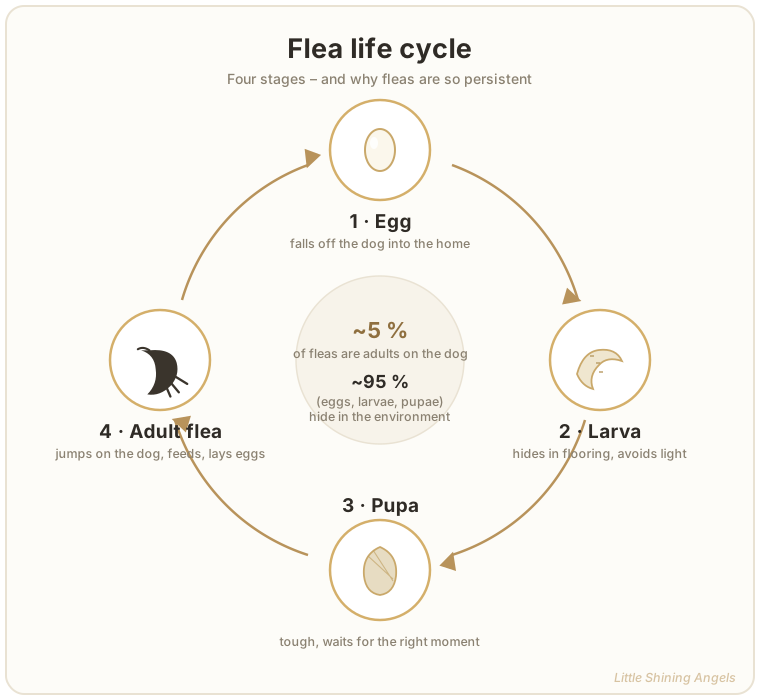
The most common is the cat flea (Ctenocephalides felis), which also attacks dogs. As Rust and Dryden (1997) describe in their foundational review, it passes through four stages: egg → larva → pupa (in a sticky cocoon) → adult flea. Adults live on the animal, all immature stages in the environment. Dryden and Rust stress that the development of immature stages is strongly governed by temperature and humidity, which explains why infestations recur so stubbornly. The ESCCAP guidelines (European Scientific Counsel Companion Animal Parasites) point to the most important fact: the pupa in its cocoon is extremely resistant and can keep releasing new fleas for weeks — in unfavourable conditions even 8 to 12 weeks. So fleas reappearing after two or three weeks should not be read as failure; it is part of the cycle, which must be broken with persistence.
How to act — step by step
- Protect all animals at once. Treat every dog in the household with a vet-recommended product (spot-on/ampoule or spray). For puppies use only a product approved by the vet, strictly per instructions — puppies are sensitive.
- Wash all textiles at 60 °C. All bedding, cushion covers, beds and puppy nests — wash at 60 °C; the high temperature destroys all stages.
- Vacuum the whole house thoroughly. Vacuuming, through vibration, prompts the pupae to emerge (when they are most vulnerable), and removes eggs and “flea dirt.” Vacuum cracks, edges and under furniture too. Discard the vacuum bag immediately after each session (sealed).
- Treat the environment. Spray cracks, floors and textiles with a proven insecticidal spray for surfaces and textiles (per instructions; keep animals out of the room during application). Disinfect work surfaces.
- Persist and repeat. Because pupae emerge gradually, repeat vacuuming and treatment regularly for several weeks (up to 8–12 weeks, depending on the cycle), until there are no more signs of fleas.
Why a protected dog is “living bait” during this time
Interesting — and useful: a properly treated dog acts as “living bait.” A flea that bites it dies because of the protective product. Combined with breaking the environmental cycle (washing, vacuuming, treatment), this speeds up the gradual disappearance of the flea population.
Conclusion
Fleas must be taken seriously — but they are entirely manageable if we are strict and consistent. The key is to understand that the battle is fought mainly in the environment and lasts several weeks. By protecting all animals, washing at 60 °C, thorough vacuuming, treating the rooms and persisting, we reliably get rid of fleas.
Literature
Rust MK, Dryden MW (1997). The Biology, Ecology, and Management of the Cat Flea. Annual Review of Entomology 42:451–473.
Dryden MW, Rust MK. The cat flea: biology, ecology and control. Veterinary Parasitology.
ESCCAP. Guidelines for the control of ectoparasites in dogs and cats.
Note: for choosing products, especially for puppies, consult your vet.