Note: this text is informational and does not replace veterinary care. In case of any deviations, consult your vet.
The first month of a puppy’s life is the fastest period of development it will ever go through. From a tiny, blind and deaf little being that can only sleep and nurse, in just four weeks it grows into a curious little explorer that already plays. Classic canine literature divides this journey into developmental periods — the foundations were laid by Scott and Fuller in their landmark study Genetics and the Social Behavior of the Dog (1965), and importantly expanded by Michael W. Fox. I follow these weeks closely here, because each one brings its own little miracle.
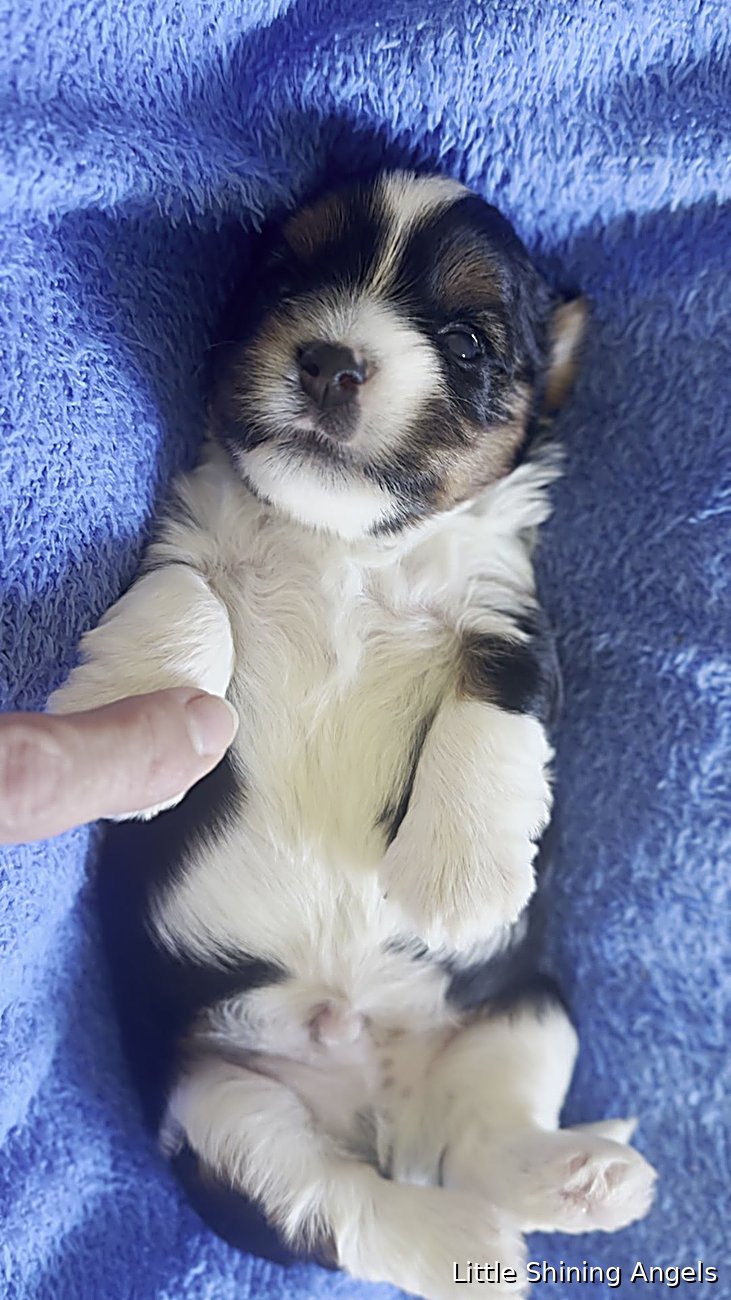
I see exactly this variety in our puppies these days: some are already taking their first wobbly steps, others roll playfully onto their backs and chase my hand, while others still sleep sweetly most of the time, curled into a warm little ball. And every one of them is exactly where it should be — each at its own pace.
Week 1 — the world is warm and safe (neonatal period)
As Scott and Fuller describe, puppies are born with their eyes and ears closed and, in the first days, live in a world of touch, warmth and smell. They sleep and nurse almost all day. They cannot yet regulate their body temperature or elimination — the mother helps with both, so her closeness is vital. Fox described the characteristic crawling in circles, in which the puppy swings its head left and right so it always finds its way back to the mother. Touch and taste already work, and weight grows fastest this week.
Week 2 — the first glimpses of light
Between ten and fourteen days, as Scott and Fuller note, the eyes slowly begin to open — at first only a tiny slit in the inner corner, which widens over a day or two across the whole eye. Vision is still hazy and immature; the puppy senses light and shapes, but not detail. Physically it grows stronger daily and already pushes up on its front legs — the first sign of the mobility to come.
Week 3 — the world opens (transitional period)
This is the period Scott and Fuller named transitional (around week 3), and the most happens at once. The eyes are now open, soon the ear canals open too (around days 19–21) and the puppy startles at sound for the first time. It takes its first unsteady steps, wags its tail for the first time, and the first milk teeth appear. Fox especially stresses that it is in this period that the first social and playful behaviour patterns awaken: the puppy rolls onto its back, opens its mouth in a playful, gentle bite, responds to touch and makes its first contact with people and with its brothers and sisters. This is the sign that it is leaving the neonatal world and entering a new one.
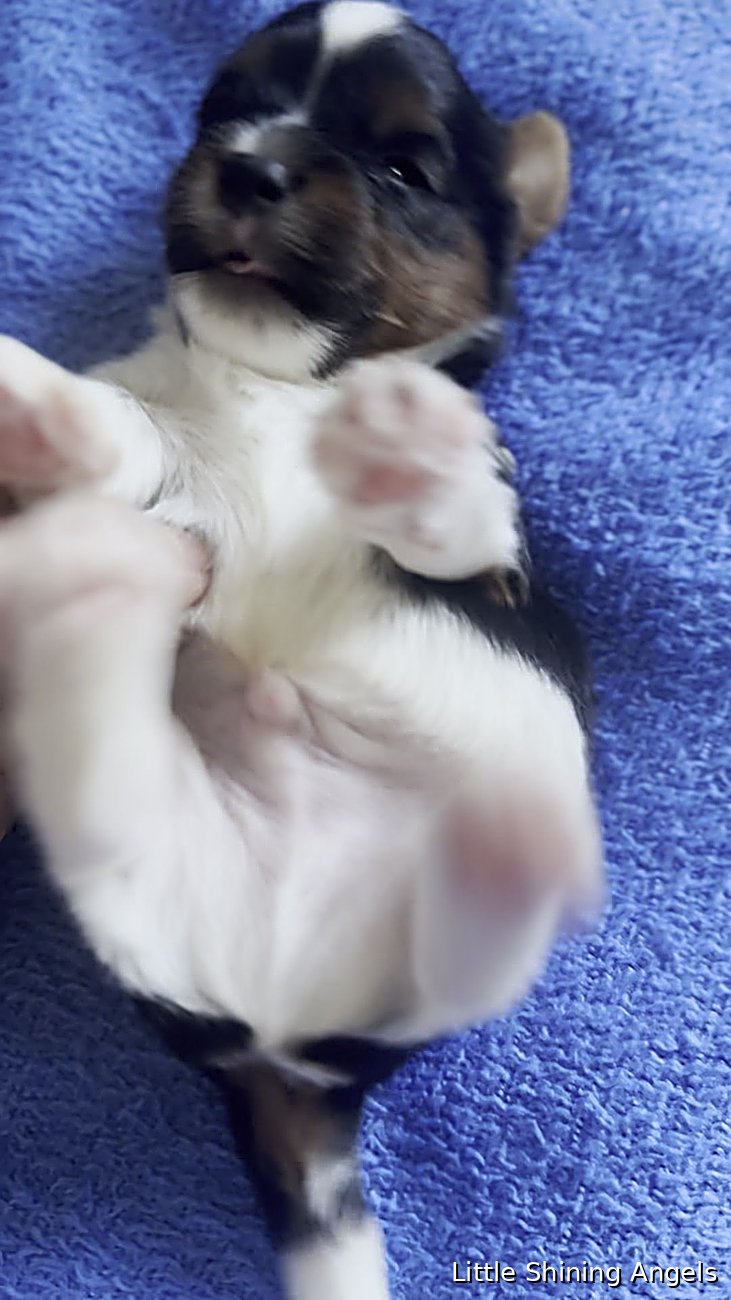
Week three: first play — the puppy rolls onto its back and chases the hand.
Week 4 — the start of socialisation and discovery
At the end of the first month, as Scott and Fuller find, the most important period of social development begins — socialisation. Walking becomes steadier, the puppies play actively with one another and with us, and their attention to their surroundings grows by the hour. Weaning also begins: the first careful tastes of solid food alongside the mother’s milk. The puppy becomes curious, brave and more of its own little self each day.
Why these weeks matter so much
This is where the essence of careful breeding lies. Scott and Fuller showed that these first weeks are so-called sensitive windows of development — periods in which experiences leave the deepest mark. Fox, through his research, pointed out that gentle, calm handling and mild stimulation at this time accelerate the maturation of the nervous system and the development of motor and cognitive abilities. That is why I give the puppies time, touch and safe closeness from the very first day — the foundations of character, trust and stability are built in exactly these weeks.
Every puppy has its own pace and the days given here are approximate. But the order of these little miracles is always the same — and every time, it is wonderful to witness.
Literature
Scott JP, Fuller JL (1965). Genetics and the Social Behavior of the Dog. University of Chicago Press.
Fox MW. Integrative Development of Brain and Behavior in the Dog.
Hastings P, Rouse ER. Another Piece of the Puzzle: Puppy Development.
Note: the days given are approximate; every puppy develops at its own pace. This text does not replace veterinary care.