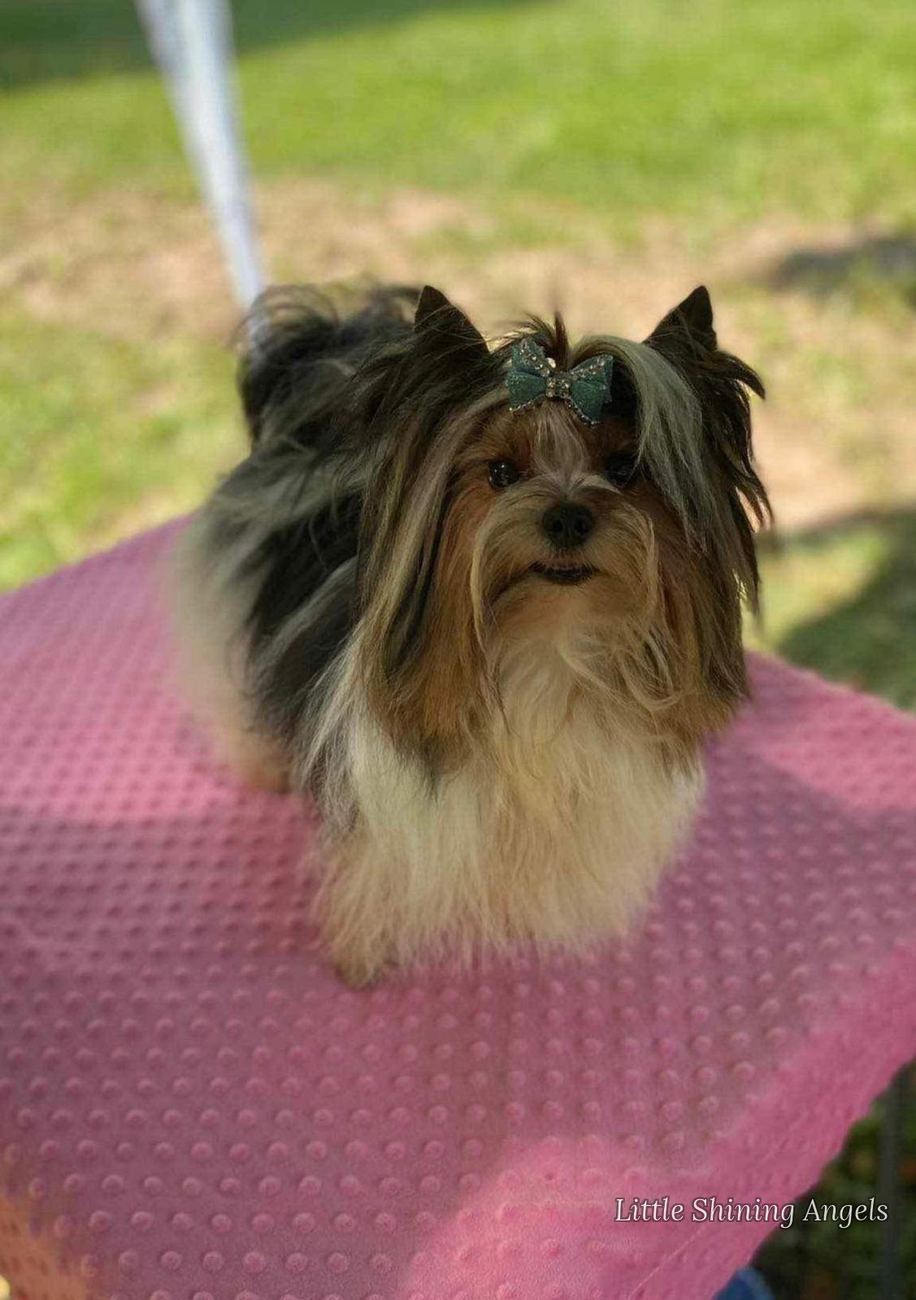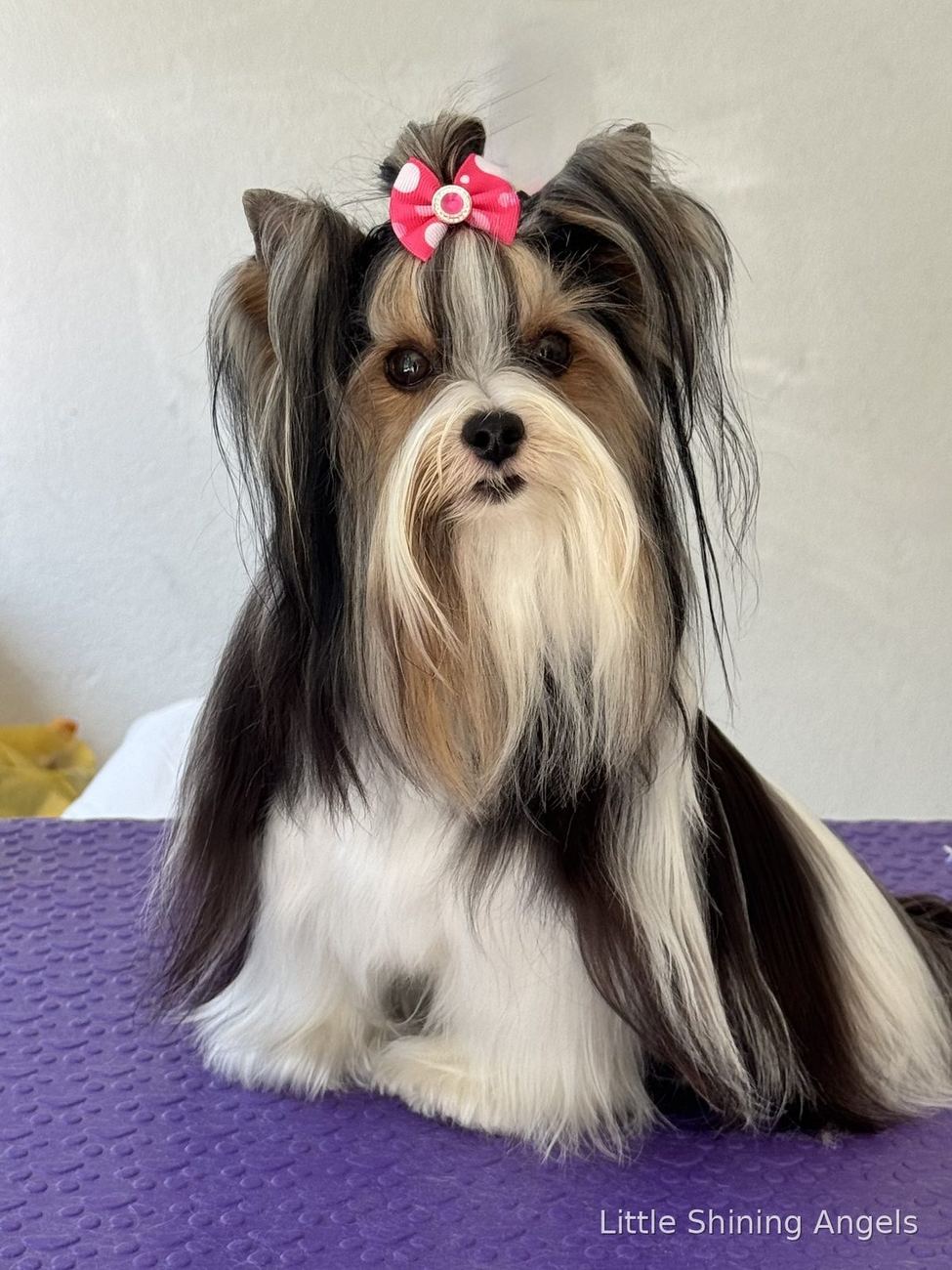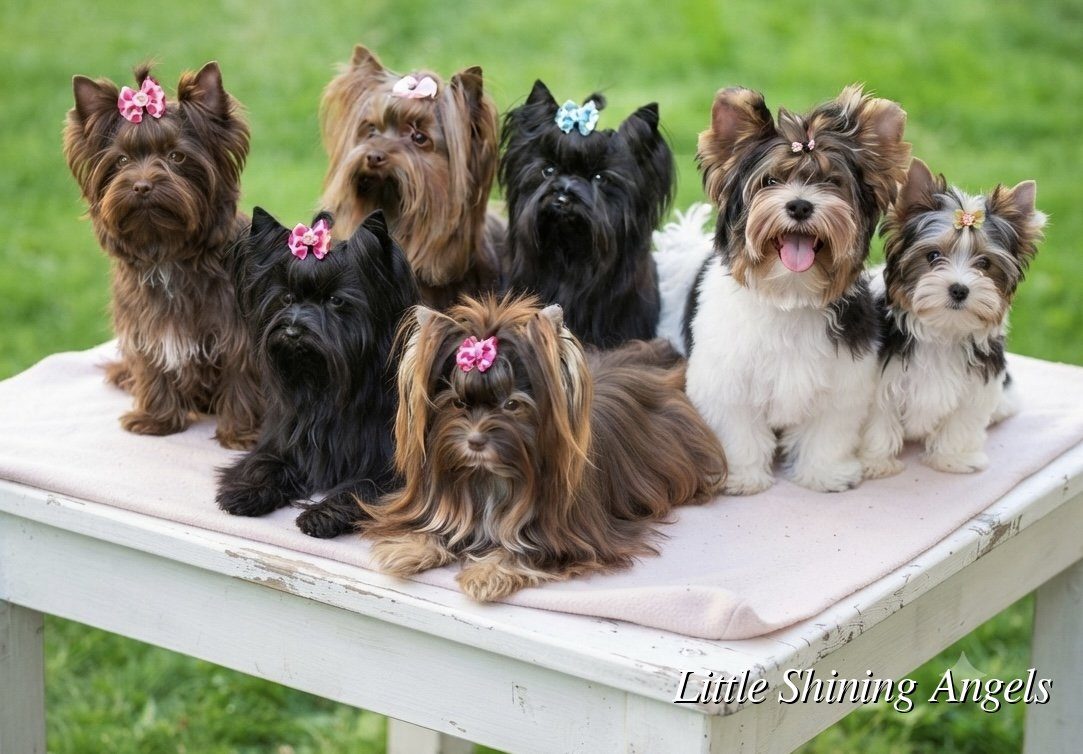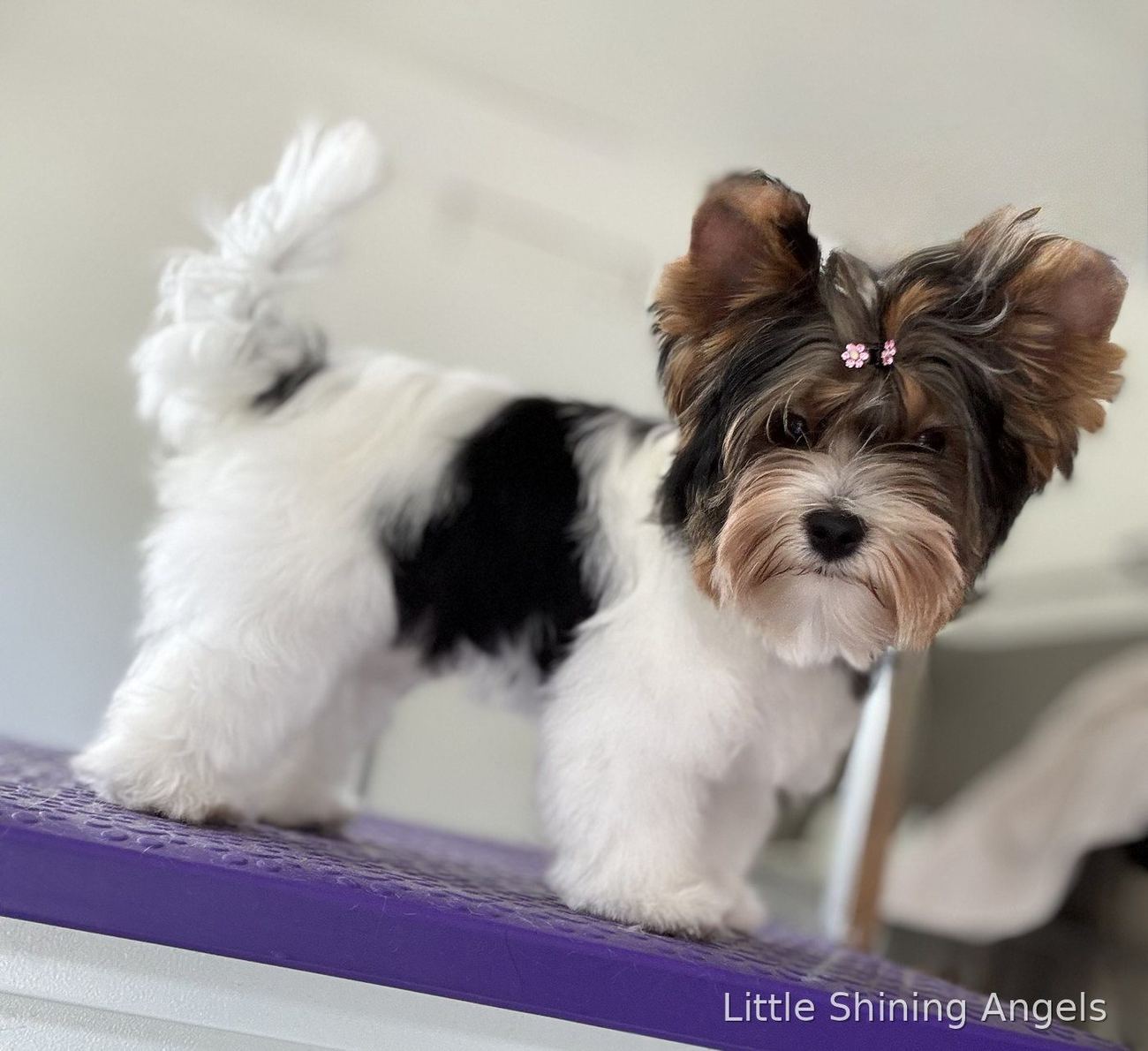
The question I hear most often is this: isn't the Biewer Terrier really just a tricolour Terrier? The answer is no, and the reason lies not in colour but in genes. This article explains what makes a Biewer a Biewer, how that distinctive pattern arises, and why it cannot be planned.
The deciding gene: MITF at the S locus
At the centre of the story is the MITF gene, located at the S locus. It acts as a master switch, governing the migration and survival of melanocytes — the cells that produce pigment — as the puppy develops in the womb.
In dogs there are two key forms of this gene. The S form means full colouring, a dog with no white areas. The s^p form, known as piebald or white spotting, produces random white areas that may cover anywhere from roughly a fifth to four fifths of the body.
Because piebald is recessive, a dog needs two copies for it to show:
S/S — a fully coloured dog, for example a classic Terrier.
S/s^p — a carrier; the dog is coloured and may have only a small white mark on the chest or feet.
s^p/s^p — the tricolour pattern, that is, the Biewer Terrier.
Why the belly, legs and tail tip are white
This is the most elegant part of the story and also the most practical.
During embryonic development, melanocytes travel outward from the spine towards the periphery of the body. Where they arrive in time, skin and coat receive pigment. Where they do not arrive, white remains.
So white is not found randomly anywhere, but most often in precisely those places furthest from the spine: the belly, the legs, the chest, around the neck and at the tip of the tail. Colour is most reliably retained where the journey began — on the head and parts of the back.
This is exactly the characteristic distribution of the Biewer Terrier, and it is why the standard requires white in those very places.
Why symmetry cannot be planned
This finding disappoints many people, but it is only honest to state it.
The distribution of white areas is highly random. Genes determine the amount of white — whether a dog will be more white or more coloured — but they cannot determine the precise map of where each patch will land. This is exactly why the perfect symmetry judges prize in the ring cannot be planned in advance.
For the same reason, a genetic test for piebald does not help Biewer breeders. The test only shows whether a dog carries one or two copies. Since purebred Biewers are homozygous, that is s^p/s^p, the result tells us nothing new. No test exists that predicts the percentage of white or its distribution.
What genuinely helps when planning a litter is knowledge of the lines. Looking only at the dam and sire is often not enough; hidden genes from grandparents and great-grandparents play a large part in the amount of white. One strong line in the background can change the appearance of a whole litter.
Chromosome 20: what separates a Biewer from a piebald Terrier
Now we come to the heart of the question of whether the Biewer is a breed in its own right.
The genetic analysis carried out by the Mars Veterinary laboratory showed that Biewer Terriers share most of their haplotypes with Terriers. That is expected, since the Terrier is the founding breed.
The exception is chromosome 20. There a haplotype was found in more than a third of the Biewers tested, and it was entirely absent in standard Terriers. The closest breed at that location is the Havanese, with other breeds of the Bichon family also close.
This matters, because it means the Biewer's tricolour is not the same mutation as in the rare piebald Terriers that occasionally appear in purebred litters. At this location the Biewer's genetic record shows a match with the Bichons.
Where the divergence began
It is often written that the Biewer is an American breed. That is not accurate.
The divergence began in Europe, not in the United States. The population that later became the recognised Biewer Terrier had already moved genetically away from the original German piebald Terriers through European lines, among them Belarusian and Russian ones. The American genetic study documented that divergence; it did not create it.
For a European breeder this matters, because it means the same genetic mix exists here too, and there is no need to look across the ocean to obtain a typical Biewer.
Where I must be careful
Here I must pause and say something openly.
It is often read online that the Biewer Terrier is a mixture of four breeds: Terrier, Maltese, Havanese and Bichon Frise. That formulation is stronger than the published data allow. The report on which the claim rests states that Biewers share most of their haplotypes with the Terrier, the main exception being chromosome 20, where proximity to the Bichons is detected.
It is therefore more accurate to say that the Biewer Terrier is fundamentally a Terrier with a documented genetic contribution from other toy breeds, which as a population has diverged enough to form its own cluster. That is no less impressive. It is simply more precise.
It is also worth repeating that this analysis was not published in a peer-reviewed scientific journal but as a technical report by the breed club.
What this means in practice
To summarise what is genuinely useful for an owner and a breeder:
Every purebred Biewer carries two copies of the piebald form of MITF, so testing them for this trait is pointless.
White cannot be predicted as a map, only as an approximate amount.
When planning a litter, knowing several generations of ancestors matters more than looking at the parents.
A dark back or a large white collar are not health faults. They are the expression of the random distribution of pigment cells.
And finally: precisely because the pattern cannot be planned, every Biewer is unique. To me that is the loveliest thing about this breed.
Literature and sources
Biewer Terrier Club of America. Biewer Terrier Data Analysis Project (technical report on the Mars Veterinary genetic analysis). biewerterrierclubofamerica.org (accessed 19 July 2026).
Biewer World. Biewer Terrier MARS Study — Data Analysis Project Update. biewerworld.com (accessed 19 July 2026).
Labogen. S-Locus (Weißscheckung, Piebald). Explanation of the MITF gene and white spotting in dogs. labogen.com (accessed 19 July 2026).
Schmutz SM, Berryere TG (2007). Genes affecting coat colour and pattern in domestic dogs: a review. Animal Genetics 38(6):539–549.
Karlsson EK et al. (2007). Efficient mapping of mendelian traits in dogs through genome-wide association. Nature Genetics 39(11):1321–1328. (Mapping of white spotting to MITF.)
Veterinary Genetics Laboratory, UC Davis. Genetic Diversity Testing for Biewer. vgl.ucdavis.edu (accessed 19 July 2026).
National Purebred Dog Day. The Biewer Terrier and the Power of DNA, 29 June 2025.
Note on reliability: the Biewer Terrier genetic analysis was not published in a peer-reviewed journal but as a breed-club technical report. Claims about contributions from other breeds are therefore stated cautiously in this text.
This text is based on current professional knowledge and on our kennel's experience. It does not replace consultation with a veterinarian or cynologist.